Wholesale Market China: A Buyer's Guide to Yiwu
How China's wholesale markets are laid out, how buying inside one actually works, and where Yiwu's districts fit — written from the buying side of the counter.
First, what a wholesale market actually is
For an overseas wholesaler, importer or chain-store buyer, the phrase "wholesale market China" usually brings to mind one image: a very large building full of stalls. That image is accurate but incomplete. A Chinese wholesale market is an organised system of districts, floors and sections, and the way buyers purchase from it is just as structured. This guide explains how the layout works and how the buying process runs, using Yiwu International Trade City as the worked example, and describes how our programme supplies goods from these categories to buyers who order remotely.
How a Chinese wholesale market is laid out
Large markets in China are not single halls. They are compounds made up of several connected buildings, usually called districts, each with multiple floors. Within a district, floors are divided into sections by product type. A section is a cluster of stalls selling the same broad category, so a buyer who needs umbrellas can walk one area rather than the entire market.
This organisation matters to buyers for three practical reasons. First, it makes comparison straightforward: similar goods sit side by side, so it is easy to see the range of specifications, materials and finishes available in one category. Second, it shortens sourcing time. A buyer with a list covering several categories can plan a route by district and floor instead of searching at random. Third, it tells you what a market is good for. These markets are built around consumer goods in large variety and modest depth per stall, which suits wholesale buyers assembling a mixed range rather than buyers seeking one narrow industrial specification in high volume.
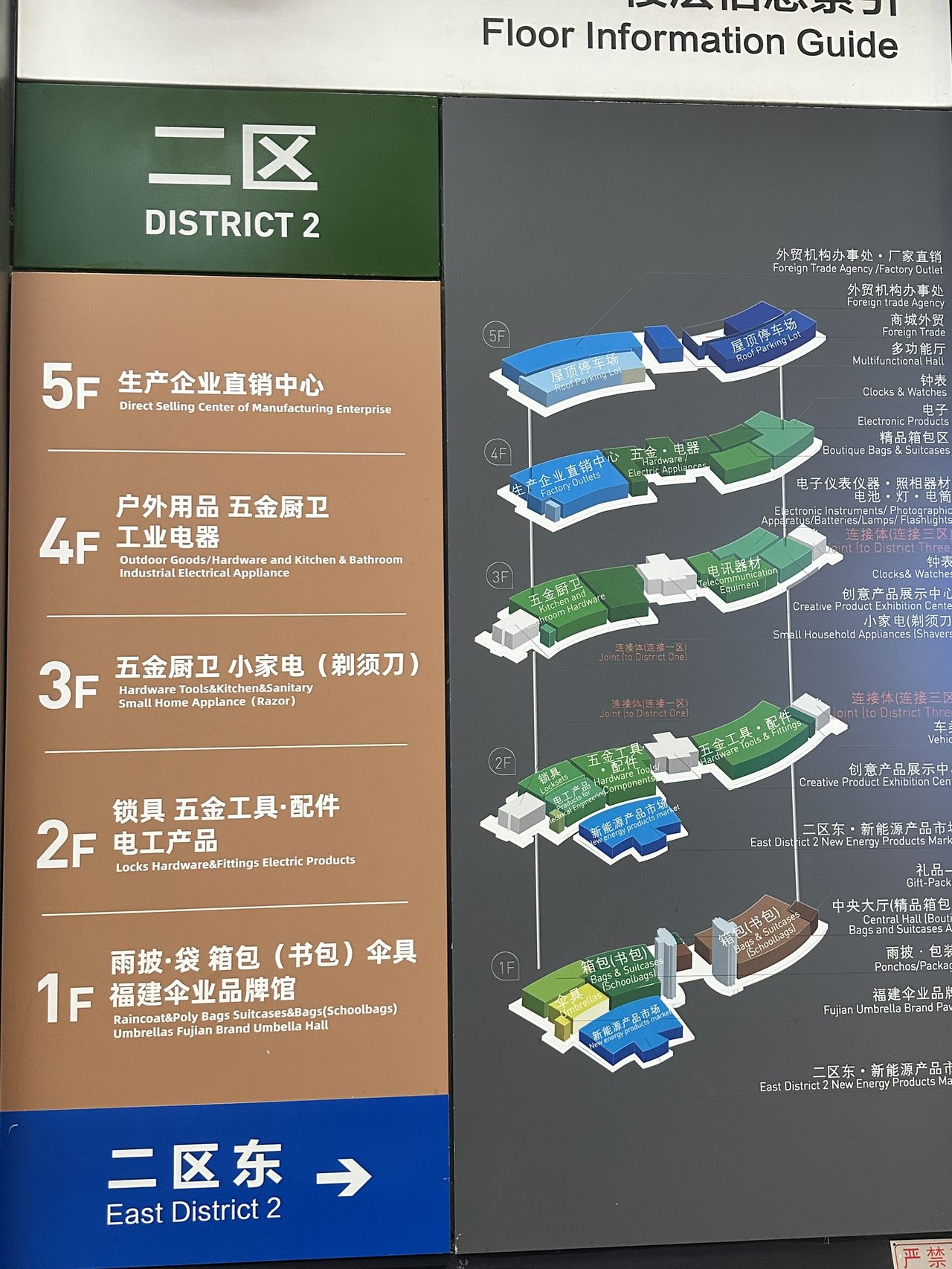
Yiwu International Trade City is a multi-district market. Each district covers different product groups, and photographed floor guides published for visitors show how the sections are arranged. Those guides are the practical starting point for any visit: read them before travelling and you can turn a vague plan into a route.
District by district in Yiwu
The floor guides show the following arrangements. District 1 includes sections for cups and kettles, for umbrellas, and for rainwear. District 3 includes sections for daily chemicals and for bags. District 4 has floors dedicated to household daily goods. District 5 covers bedding, curtain fabrics, automotive accessories and imported goods.
Read as a buyer, that list describes several distinct sourcing trips rather than one. Cups and kettles sit near umbrellas and rainwear in District 1, which is useful if your range includes household drinkware alongside seasonal weather goods. Daily chemicals and bags in District 3 are separate sections, so plan them as separate stops. Household daily goods occupy floors in District 4, which means the category is deep enough to justify time rather than a quick pass. District 5 gathers bedding and curtain fabrics together with automotive accessories and imported goods, a combination that suits buyers building a home-and-living range with an automotive add-on.
Two points follow from this. First, no single visit covers the whole market well. A buyer with a broad list should pick two or three districts and accept that the rest will be handled later or remotely. Second, the district structure is also a useful map of our own catalogue. We supply goods by category, and the categories above correspond to the sections buyers visit in Yiwu. If you cannot travel, you are not shut out of the market; you are ordering from it through a supply programme instead.
How buying actually works
Buying from a Chinese wholesale market at wholesale scale is not the same as shopping. Three mechanics decide whether an order is workable: minimum order quantities, sampling, and how goods are consolidated for shipment.
Minimum order quantities
In our programme, category MOQs typically run from 100 to 800 pieces per style. The range is wide because it reflects real differences between categories: small consumer items can be ordered at the lower end, while larger or more complex goods sit higher. The practical consequence is that a wholesale order is usually a commitment per style, not per unit. When you plan a range, check the MOQ for each category before you finalise the assortment, because a long list of styles at low quantities each may not meet the per-style minimums. A shorter list of styles at workable quantities usually is.
Samples before orders
Samples come before orders. Ready samples are available free or at low cost, with courier charges collected. This is the point at which specification questions get settled: material, finish, dimensions, packaging and labelling. Treat sampling as a working step rather than a formality. Compare the sample against your own requirements, confirm what will change for production, and only then place the order. Because ready samples are low cost, it is practical to sample several styles across categories before narrowing down.
Mixing SKUs and categories in one container
Mixed-SKU and mixed-category container loading is available. This is the mechanic that makes a market like Yiwu useful to a wholesaler or chain-store buyer: you are not required to fill a container with one product. A single container can combine styles and categories, which means a mixed range can ship together instead of being split across several shipments. For buyers whose business is built on variety, this is often the difference between an order that works and one that does not.
The standard order cycle is 30 to 90 days. That span covers the range from straightforward repeat styles to orders that need production and packing changes. Plan your stock and cash flow around the cycle rather than around a single expected date, and build in time for sampling before the cycle begins.
Quality and shipping, handled in the right order
Quality control and shipping are often discussed together, but they happen in sequence, and getting the order wrong causes problems. Inspection comes before shipment, not after.
Inspection before shipment
Pre-shipment inspection is carried out to AQL, with photo and video reports. In practice this means goods are checked against an accepted quality level before they leave, and you receive visual evidence of what was inspected. The report is your record before the container is sealed. Review it promptly and raise any issue while the goods are still at the loading point, because corrections after departure are far more difficult.
Compliance paperwork
On compliance, test reports and certificates can be arranged with third-party laboratories per product and destination market, and certificates are available upon request. What can be arranged depends on the product and on the market you are importing into, so raise the requirement when you enquire rather than after the order is placed. We do not claim that products are certified; we describe what documentation can be arranged for your destination.
Export route and transit times
FOB Ningbo or Shanghai is the standard export route. Sea freight from these ports takes 30 to 45 days to Europe and 35 to 50 days to the US West Coast. Add the 30 to 90 day order cycle, and you have a realistic timeline from order confirmation to goods in your warehouse. For buyers running promotions or seasonal ranges, that total is the number to plan against. If your requirement is urgent, say so at enquiry stage so the timeline can be discussed honestly before you commit.
When a market visit is worth it — and when it is not
Travelling to Yiwu is useful, but it is not the only way to buy, and it is not always the best use of a buyer's time. The honest trade-offs are worth setting out.
What remote ordering gives you
Remote ordering with samples and inspection reports covers most of what a market visit provides for established categories. You receive samples to assess specification, an AQL inspection with photo and video reports before shipment, and mixed-category container loading. You avoid travel cost and time, and you can run the process alongside your existing work. For repeat orders, range extensions in categories you already know, and buyers with clear specifications, remote ordering is usually the more efficient route.
What a visit adds
A visit adds most when the product is new to you, when a category has many variations you need to see and handle side by side, or when you want to meet suppliers and assess how they work. The district layout described above is what makes a visit productive: with the floor guides and a shortlist of districts, two or three days can cover a focused list well. Without that preparation, a visit can turn into walking.
For buyers who do travel, support is available: airport and hotel pickup, and accompaniment on factory visits. Factory visits are a separate activity from the market itself; the market is where goods are shown, and a factory visit is where you look at production. If you want both, plan them as separate parts of the trip and allow time for travel between them.
Matching the route to the buyer
A first-time buyer assembling a mixed container across several categories will usually benefit from sampling remotely first, then travelling once the shortlist is narrow. A buyer extending a proven range can order remotely and rely on inspection reports. A buyer entering a category with many similar options should see the goods in person before committing to styles. None of these routes is closed; they are different sequences of the same steps: sample, confirm, order, inspect, ship.
Our catalogue is organised by category, and several of its sections map directly onto the market districts described here — bags, household daily goods and home textiles among them. Orders are subject to category MOQs of typically 100 to 800 pieces per style, sampled before production, inspected to AQL before shipment, and shipped FOB Ningbo or Shanghai with mixed-SKU and mixed-category container loading available. If you are planning a range and want to know what a category looks like in practice, request ready samples and start there.